Ohio Licensing
Cosmetology licensing, decoded for a 15-year-old.
Before Joslynn’s Salon & Cafe can open its doors, Ohio requires one thing above all: a licensed professional behind the chair. Here is the whole path — school, hours, exams, renewal — in plain language.
The Path at a Glance
From enrollment to licensed in five steps.
Enroll
Choose a cosmetology school approved by the Ohio State Cosmetology and Barber Board and enroll once you meet the age and education requirements.
Train
Complete your required training hours — cutting, coloring, chemistry, sanitation, and client care — logged and verified by your school.
Apply
Your school certifies your hours to the Board, and you submit your application to sit for the licensing examinations.
Examine
Pass two exams: a written theory test on what you know, and a practical test on what your hands can do.
Licensed
The Board issues your cosmetology license. You can now legally work on paying clients in Ohio — and start building the business.
Requirement 01
Minimum age
Ohio typically allows students to begin cosmetology school around age 16 — which is exactly why this roadmap treats age 15 as the dreaming-and-preparing year and age 16 as the year professional training begins.
Being young is not a disadvantage here. Starting training at 16 means a license can realistically be in hand before most people have picked a college major. Every year of a head start compounds.
Requirement 02
A Board-approved school
Not every beauty program counts. Training must happen at a school approved by the Ohio State Cosmetology and Barber Board — the state agency that regulates the profession. Approved schools follow a state-reviewed curriculum, employ licensed instructors, and can certify your hours to the Board.
When touring schools, ask directly: “Are you Board-approved, and what is your exam pass rate?” A great school is proud to answer both.
Requirement 03
Training hours — the craft takes time.
Ohio requires a substantial block of supervised training — for full cosmetology, typically on the order of 1,500 hours, though the exact number is set by the state and can change. Think of it as roughly a year of full-time study, or longer part-time alongside high school.
Those hours are not busywork. They cover haircutting and styling, chemical services like color and texture, skin and nail basics, sanitation and safety, and — often overlooked — the client communication skills that fill an appointment book.
Some Ohio high schools offer career-technical cosmetology programs that let students earn hours during junior and senior year, often at little or no cost. That is one of the smartest moves on this entire roadmap — ask a school counselor about it early.
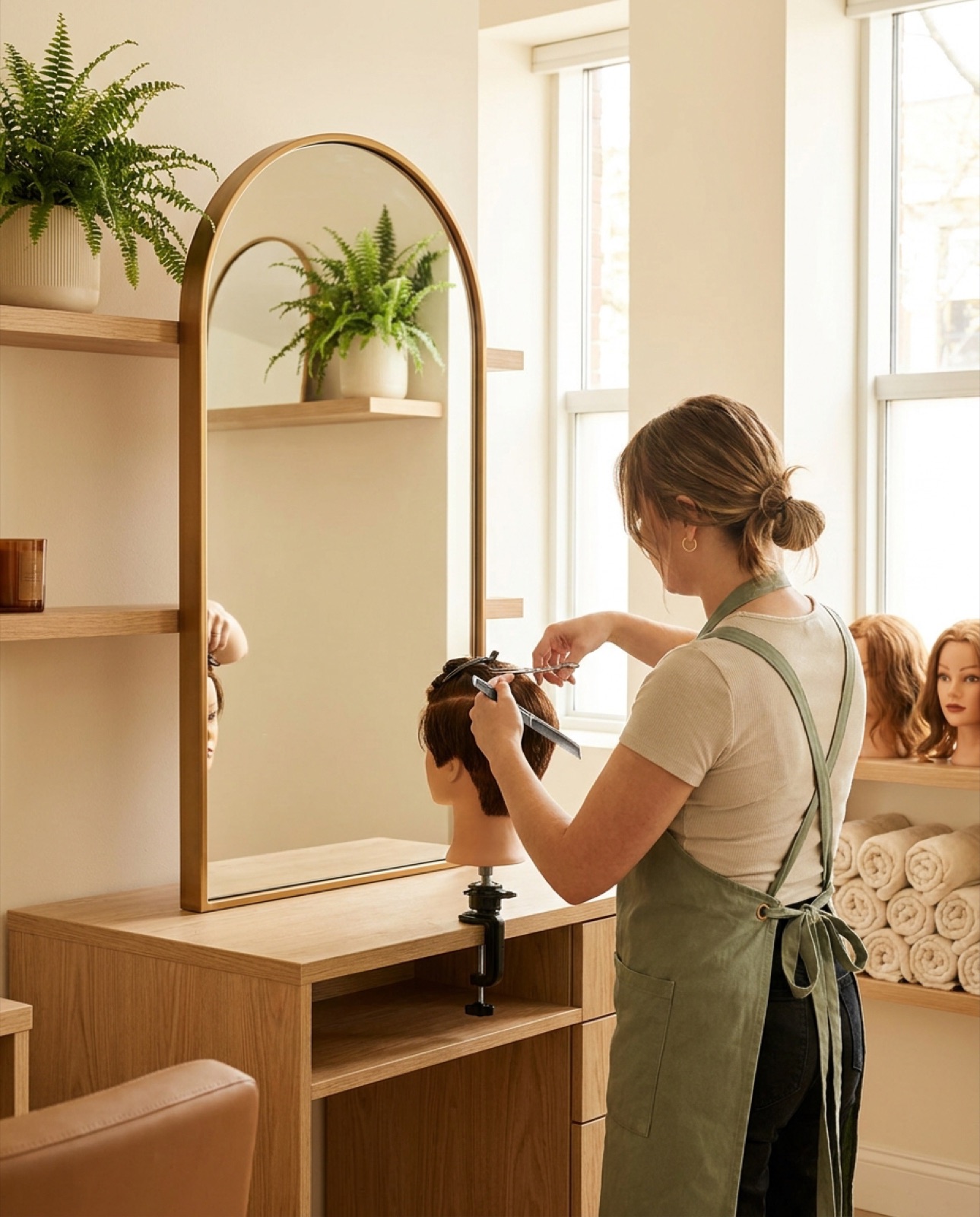
Training Study 01
Mannequin heads · shears · color bowls · logged hours · licensed instructors
Requirement 04
Two exams, one license.
Exam One
Written theory
A computer-based test covering everything from hair science and chemistry to sanitation rules and Ohio law. It proves you understand the “why” behind every service — why a certain developer volume, why a certain disinfection step. Your school prepares you for it throughout the program.
Exam Two
Practical skills
A hands-on demonstration of core techniques performed under observation — sectioning, cutting, chemical application procedure, and safe handling of tools. Steady hands and calm nerves win here, and both come from the hundreds of practice hours already behind you.
After the License
Renewal
A license is not forever-stamped — Ohio licenses renew on a regular cycle, typically every couple of years, with a renewal fee paid to the Board. Miss the deadline and you cannot legally work until it is fixed, so future-you should treat the renewal date like a client appointment: on the calendar, with a reminder.
For a salon owner, renewal matters twice over — your own license, and confirming every stylist you hire keeps theirs current too.
Never Stop Learning
Continuing education
Ohio typically ties license renewal to continuing education — a set number of hours of approved coursework on topics like safety, sanitation, and new techniques. The state’s goal is simple: nobody should be working on clients with knowledge frozen in the year they graduated.
Honestly, the best stylists blow past the minimum anyway. Advanced color certifications, cutting academies, barbering crossover classes — every class is a new service you can charge for.
What the License Unlocks
One license, six careers.
A cosmetology license is not one job — it is a passport. Every path below starts from the same credential, and none of them are locked: many pros move between several over a career.
Salon Stylist
The classic path — cutting, styling, and building a loyal book of clients behind the chair.
Color Specialist
Deep expertise in color theory and technique. Great colorists are among the most sought-after (and best-paid) people in any salon.
Salon Owner
The destination of this whole roadmap. A license plus business skills equals a salon with your name on the door.
Educator
Teach at a cosmetology school or train stylists for a product brand. Experienced educators shape the next generation.
Platform Artist
Perform techniques live on stage at trade shows and industry events for brands — part stylist, part performer.
Editorial Stylist
Style hair for photo shoots, fashion shows, film, and magazines — where hair becomes art direction.
The license is step one. The company is the destination.
See exactly where training hours, exams, and licensure fit inside the five-year plan — year by year, age by age.